The home-support notebook
Home health care starts with a conversation.
Make room for the questions that matter. Explore everyday support, collect your thoughts, and use 8 common questions to prepare for a conversation with a qualified professional.
Open the reading notebookFor individuals, families, and people helping someone plan.
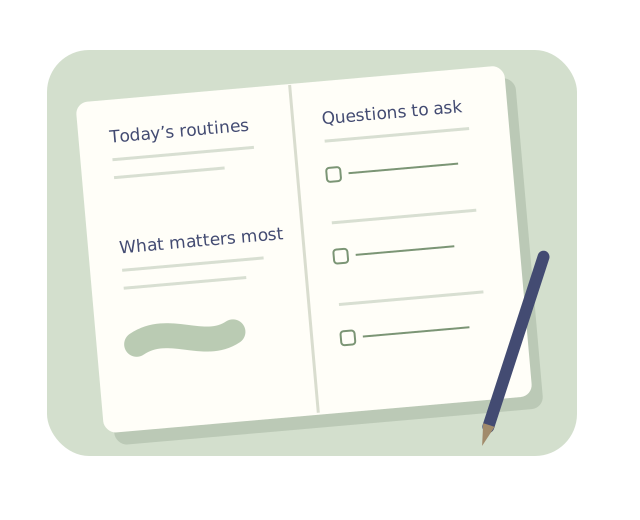
A little preparation. A clearer conversation.
01 / Notice the everyday
Home health care questions begin at home.
Start with the person’s experience of an ordinary day. Specific examples can make a discussion easier to follow than a broad request for help. These three areas offer a useful place to begin.
Routines & practical tasks
Write down which daily activities feel manageable and where help would be welcome. Include preferred times, familiar routines, and any arrangements already in place. Ask a qualified provider which kinds of support fit the situation.
Preferences & independence
Ask what the person wants to keep doing for themselves and how they prefer to receive assistance. Small details about privacy, language, food, or household habits can be meaningful. Record their own words when possible.
Communication & coordination
Agree who will collect questions and who may receive updates. Make a note of the preferred way to communicate, then ask a provider how information is shared. Clarify responsibilities rather than assuming everyone has the same understanding.
02 / Bring a page of notes
Prepare for a useful discussion.
A short, organized page can keep a conversation focused. It does not need to tell the whole story at once. Leave space to capture answers and identify anything that needs a second conversation.
Explore the family resources article ↗Describe today.
Choose two or three concrete examples from daily life. Distinguish what you have observed from what you are unsure about.
Write the next question.
Ask about the scope of support, the people involved, and the steps needed to understand a proposed arrangement.
Confirm your understanding.
Repeat back key points, request clarification in plain language, and agree who will follow up on unanswered questions.
03 / Find your next page
Read with a question in mind.
Browse a topic, keep track of the source and publication date, and bring questions to a professional who understands your circumstances. Older articles may need context before you use them.
Blog ↗
Explore the article archive and choose a subject to discuss.
Broader topicsOther ↗
Find additional perspectives across the resource collection.
Question-led readingPatient questions ↗
Use existing questions as a starting point for your own notes.
You can also visit the About page or review the existing services article. Confirm current details directly with the relevant provider before relying on a description.
04 / Questions to keep close
A clearer place to begin.
These answers offer general preparation guidance. Individual needs, professional responsibilities, and service arrangements require a direct conversation.
What can I find in this home health care resource?
You can find a starting point for organizing home-support questions, exploring reading topics, and preparing for a conversation with a qualified professional. Use the notebook prompts to describe everyday needs and preferences. Information on a website cannot establish which services are appropriate or available for an individual.
How should I prepare for a first conversation?
Start with a short description of a typical day and the tasks where support would be welcome. Add the person’s priorities, communication preferences, and questions about arrangements. Bring relevant documents through the provider’s recommended process, and ask what additional information they need before making any decisions.
Who should take part in planning?
The person receiving support should guide the conversation as much as possible. With their permission, a family member, trusted friend, or representative can help record questions and clarify preferences. Ask the provider how they involve participants and handle consent, privacy, and decisions when circumstances change.
What should I ask about a provider’s role?
Ask which tasks the provider can perform, who is responsible for each task, and which requests require a different professional. Confirm qualifications directly with the provider and relevant official sources. A clear explanation of responsibilities helps everyone understand the boundaries of a proposed arrangement before it begins.
Can these pages tell me which medicine to take?
No. These pages do not provide individual medicine choices, doses, or instructions for changing a prescription. Take medication questions to a pharmacist or the prescribing professional. Ask them how to maintain an accurate list and how any relevant instructions should be shared with people involved in support.
How can I keep useful notes without oversharing?
Keep notes focused on the question you need answered, and store personal information somewhere secure. Before sending a document, ask the intended recipient which details they need and what communication method they recommend. Agree with the person receiving support about who may see or update shared notes.
What details should I confirm before arranging support?
Confirm the proposed tasks, schedule, costs, cancellation terms, and point of contact directly with the provider. Ask how changes are discussed and documented. Coverage and eligibility depend on individual arrangements, so seek written clarification from the relevant provider or payer instead of assuming a website description applies.
How do I use the reading sections?
Begin with a question that matters to your household, then browse Blog or Other for related material. Note the article’s date and context, and write down anything that needs clarification. Use what you read to support a conversation, rather than treating general articles as personal advice.
One question at a time
Your next step can be a simple one.
Choose one topic to read, write down what matters to you, and keep your questions together for the next conversation.
Explore more reading